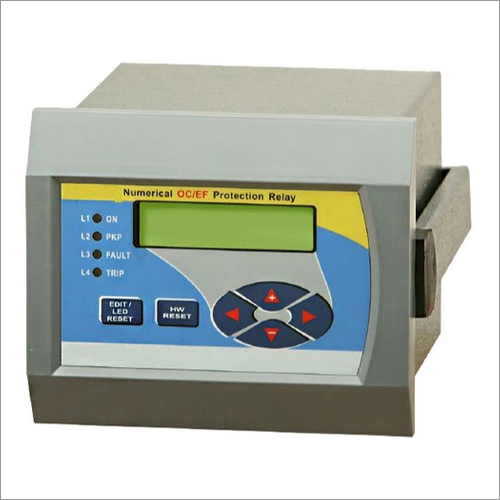
NUMERICAL RELAYS
At CSSPSS, we specialize in delivering top-tier Numerical Relays tailored to meet the complex protection and control needs of modern power systems. Our range of microprocessor-based relays offers superior accuracy, flexibility, and reliability compared to traditional electromechanical devices. With years of experience in power system protection, we take pride in offering advanced solutions that adhere to the highest standards of quality and compliance.
Whether it's protecting transmission lines, transformers, or motors, we've got you covered. We work closely with our clients to provide customized relay settings and configurations that suit their specific network requirements. Our commitment to engineering excellence, timely delivery, and attention to detail makes us the preferred choice for all your electrical protection needs. Trust us to safeguard your assets with expertise and care!
FUNCTIONALITY
CSSPSS’s Numerical Relays function as the intelligent brain of an electrical protection system. Equipped with high-speed microprocessors and Digital Signal Processors (DSPs), these devices continuously sample analog current and voltage inputs from CTs and PTs. They convert these signals into digital data and compare them against pre-programmed protection logic and settings (such as Overcurrent, Earth Fault, or Differential). Upon detecting a fault condition, the relay executes the programmed trip logic in milliseconds, sending a signal to the circuit breaker to isolate the fault, while simultaneously recording event data for analysis.
Technical Specifications
| Parameter | Specification |
|---|---|
| Rated Current (In) | 1A / 5A (Selectable) |
| Rated Voltage (Un) | 100V - 240V AC/DC (Wide Range Aux Supply) |
| Frequency | 50Hz / 60Hz |
| Protection Functions | Overcurrent (50/51), Earth Fault (50N/51N), Differential (87), Overvoltage/Undervoltage (27/59) |
| Communication Protocols | Modbus RTU, IEC 61850, IEC 103, DNP3, Courier |
| HMI Interface | Backlit LCD / TFT Touchscreen with Keypad |
| Accuracy Class | Class 0.5 / Class 1.0 for Metering |
| Operating Temperature | -25°C to +55°C (Standard) |
| Binary Inputs/Outputs | Configurable (8-24 Inputs / 8-16 Outputs typical) |
| Compliance | IEC 60255, IEC 61000, IEC 61850-3 |
Key Benefits
- Superior Accuracy: High-precision measurement ensures accurate fault detection and minimizes nuisance tripping, improving system reliability.
- Multi-Functionality: A single numerical relay can perform multiple protection functions (Overcurrent, Earth Fault, Overload) replacing several electromechanical relays.
- SCADA Readiness: Built-in communication ports allow seamless integration with SCADA and automation systems for remote monitoring and control.
- Fault Analysis: Integrated disturbance recording and event logging features enable detailed post-fault analysis to prevent future occurrences.
- Compact Design: Space-saving design reduces panel footprint compared to older relay technologies.
- Programmable Logic: Allows custom logic schemes without hardwiring, offering flexibility for complex network configurations.
- Self-Monitoring: Continuous self-diagnosis capabilities alert operators to internal hardware or software issues, ensuring the relay is always ready to operate.
Applications
- Transmission Lines: Distance protection and pilot wire protection for high voltage grids.
- Transformer Protection: Differential and restricted earth fault protection for power transformers.
- Motor Protection: Thermal modeling, unbalance, and stall protection for industrial motors.
- Generator Protection: Comprehensive protection for synchronous generators against internal faults.
- Distribution Feeders: Overcurrent and Earth Fault protection in substations.
- Busbar Protection: High-impedance or low-impedance schemes for busbar zones.
- Capacitor Banks: Protection for power factor correction capacitor banks.
- Smart Grids: Feeder automation and auto-reclosing schemes for modern distribution networks.
Engineering Excellence
- Robust Firmware: Our relays run on validated, bug-free firmware designed for stability and deterministic operation.
- Rugged Hardware: Designed to withstand harsh industrial environments with high immunity to electromagnetic interference (EMI).
- User-Centric Interface: Intuitive HMI layouts make configuration and troubleshooting straightforward for operators.
- Thermal Design: Efficient heat dissipation ensures reliable operation across a wide temperature range without derating.
- Modular Architecture: Plug-in modules for I/O and communication allow for easy upgrades and maintenance.
Quality Assurance
- Type Testing: Verified according to IEC 60255 standards for safety and performance.
- EMC Testing: Rigorous electromagnetic compatibility tests to ensure operation in noisy electrical environments.
- Environmental Testing: Tested for extreme temperatures, humidity, and vibration.
- Software Validation: Algorithm verification to ensure correct tripping characteristics under all fault scenarios.
- Production Testing: Every unit undergoes functional testing and calibration before dispatch.
Key Features
Digital Signal Processing
High-speed sampling and processing for accurate fault detection and measurement.
Event & Fault Recording
Stores fault waveforms and event logs to analyze system disturbances post-trip.
Communication Ports
Standard RS485 and Ethernet ports for Modbus, IEC 61850, and DNP3 communication.
Multi-Function Capability
Combines protection, control, and metering in a single device.
Programmable Logic (PLC)
Configurable logic gates and timers for custom control schemes.
Built-in Metering
Real-time display of Current, Voltage, Power, and Energy values.
Multiple Setting Groups
Allows switching between protection settings for different network configurations.
High-Speed Operation
Sub-cycle tripping times for critical protection applications.
Self-Supervision
Continuous hardware and software health monitoring with alarm outputs.
Graphical HMI
Intuitive display for single line diagrams and phasor visualization.
Non-Volatile Memory
Retains settings and records even during power loss.
Time Synchronization
IRIG-B or SNTP support for accurate time-stamping of events.
Easy Retrofitting
Compact dimensions designed to fit into existing switchgear retrofit projects.
Why Choose CSSPSS
CSSPSS is a trusted leader in power system protection, renowned for delivering state-of-the-art Numerical Relays with unwavering commitment to quality.
Technical Expertise
Our engineers are experts in protection grading, relay coordination, and settings calculation.
Quality Products
We supply relays from globally recognized brands and our own certified product line.
Comprehensive Support
From commissioning to post-fault analysis, we provide complete technical support.
Future-Proof Technology
Our solutions are designed for Smart Grid integration and Industry 4.0 compatibility.
Global Standards
All products adhere to IEC and IEEE standards for international compliance.
Proven Track Record
Years of experience in protecting critical infrastructure across various industries.
Frequently Asked Questions
A Numerical Relay is a microprocessor-based protective device used in electrical systems. It converts analog current and voltage inputs into digital data to perform precise mathematical calculations for fault detection, offering superior functionality compared to electromechanical relays.
Electromechanical relays use mechanical moving parts and induction discs to operate, which can wear out over time. Numerical relays have no moving parts, offer much higher accuracy, can perform multiple protection functions in one unit, and provide data logging and communication capabilities.
Yes, almost all modern numerical relays come with built-in communication ports (RS485, Ethernet) and support standard protocols like Modbus, IEC 61850, and DNP3, making them fully compatible with SCADA and automation systems.
Multiple setting groups allow operators to switch between different protection configurations instantly. This is useful for networks that change topology (e.g., a feeder normally fed from Station A might be fed from Station B during maintenance), requiring different sensitivity settings.
They require significantly less maintenance than electromechanical relays because they have no moving parts. However, periodic testing is recommended to verify the health of the internal power supply, accuracy of measurement, and proper operation of the trip circuits.